My dissertation advisor Gil Hanson quipped that
the Gazelle and similar utilitarian bicycles in Germany were ubiquitous. He was right. I spent last week in
Bremen at the Thermo-Fisher factory, staying in the old city center and taking the excellent tram back and forth between the factory (at the airport) and my hotel in the old historic city center, a block from the
Domsheide tram stop.
 |
| Mail carrier. Stock web photo; I didn't get my own. |
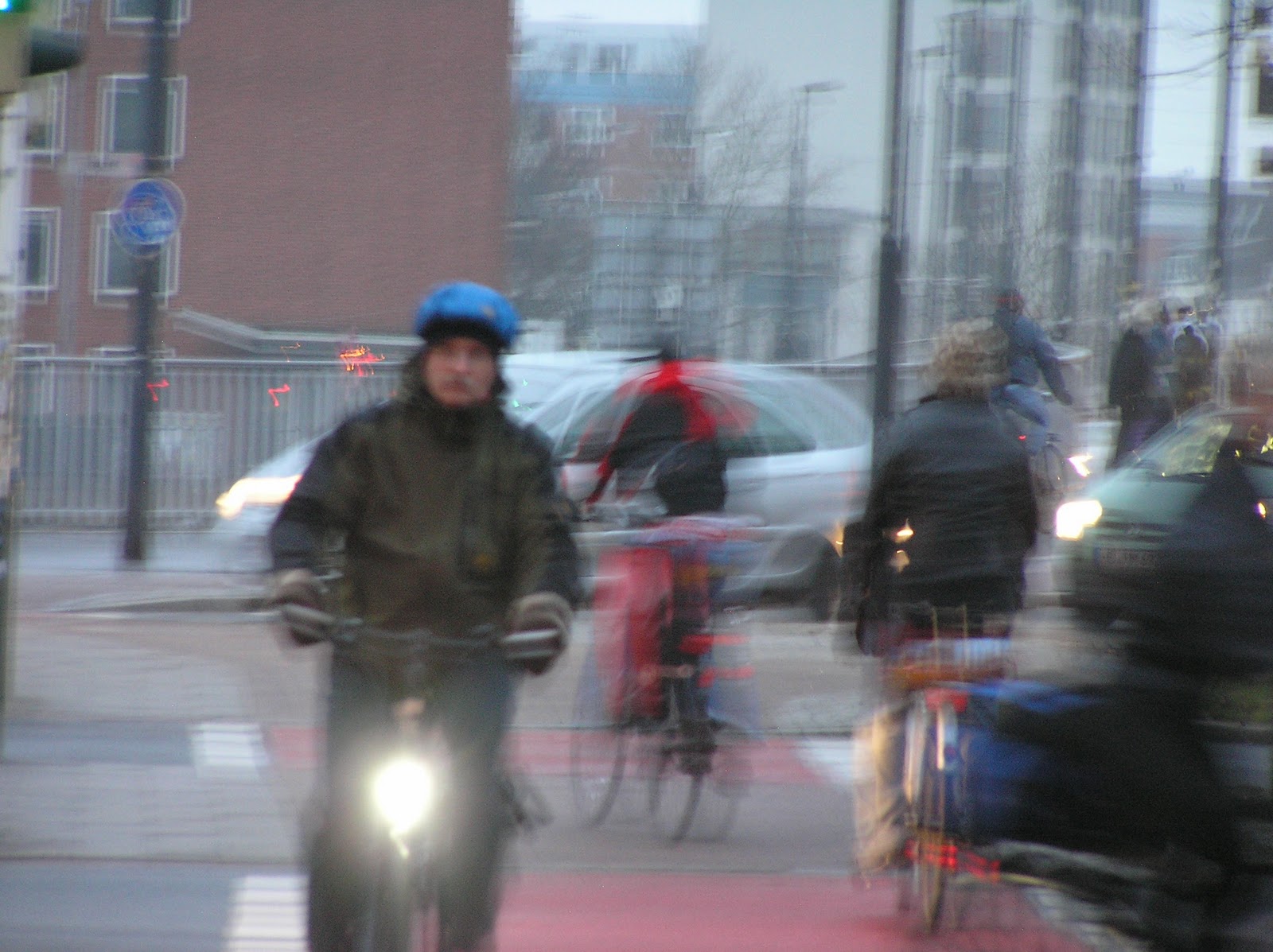
It was rare to not see one or many Gazelle or similar utilitarian bikes cruising by anywhere I went, silently taking its pilot, including the German mail carriers, somewhere or other at about 8-10 mph. Mind you, this was the dead of winter with fog, rain, damp, cold, and very short days; Bremen is at a similar latitude as Hudson Bay. Nonetheless, bicycle mode share (2007) was 22% in Bremen according to
this document from
Add Home(EU). The bike mode share in Bremen is
far higher than in most U.S. cities considering themselves bike-friendly. Cars still have a strong presence in Bremen in terms of sheer numbers, but the coexistence of cyclist and motorist is not an arrogant hierarchy or a ridiculously lopsided arrangement like here in the States. At times, the visual mode split was almost even.
 |
| Bike racks are rarely empty in Bremen, Germany |
People don't ride the Gazelle or similar utility bikes to break speed records, impress themselves, get their bodies buff, or to bathe themselves in sweat. Quite the contrary. They ride them as effective, affordable transportation to get somewhere, such as to a restaurant or other destination, in city clothes and in city comportment. They are fit, though. One guy was riding too fast on the Weser River pathway on a sunny, busy Sunday where everyone and his dog was out enjoying a rare warm and sunny day. Blowing by and through walkers, he was greeted with curses and reproach. But he was quite a rarity.
 |
| Day or night, rain or shine, the bike, with lights and fenders, moves people |
|
The Bremen system, like most in Germany, is set up for utilitarian cycling; cyclists have dedicated pathways (see Gil Hanson's
excellent description). Many Bremen sidewalks (and those in other German cities) are divided into bike and ped segments. These are well defined with different color pavement, have separate bike and ped traffic light cycles illustrated by small dedicated traffic lights (see photo below and
link here), and above all, are used by people who obey the rules. That means everyone. I saw one bicyclist blow a light all week. I didn't see any motorists blow a light. I think I was the closest thing to a near miss, as I kept drifting into the bicyclist's portion of the sidewalk.
Although many American vehicular cyclists ("VC" here, and I count myself as a VC) swear that these systems cannot work, I came back convinced that what makes them work or not work is not religion (after all, one sees one's world through one's own paradigm) but good engineering within a well defined paradigm coupled with people obediently using the system within well defined operational parameters. Anyone riding too fast with their nose to the drop bars would be deadly or dead on the Bremen path system. Note: I didn't get out into the country, but suspect there are plenty of places to get out and hammer.
 |
| Weser R. crossing. Red (l) is for bicyclists, grey (r) for peds. |
The arguments about the German system working (or not) depend on adopting the Euro "bike as utility vehicle" or American VC model, which some do with a fervor bordering on religious fanaticism. Frankly, in raising mode share, one has to admit the German system works with typical German efficiency. But its not entirely altruistic and it doesn't work in a social vacuum, as many Americans think it could--it is part of a profoundly different socially engineered transportation system.
Gas is
taxed heavily to reduce consumption; the engineer I worked with all week, who lives in his ancestral town about 30 km from the Bremen Airport says
he pays about 1.5 Euros per liter for gas or diesel, almost eight bucks a gallon. Much of that price is tax. Sure, many drive, but I didn't see an SUV all week. Small, fuel-sipping cars and mini-utility pickups ruled. People also ride bikes or take transit in great numbers because Germany, like most European societies, socially engineered itself to eliminate as much non-essential gasoline consumption as it could through postwar urban design (see Gil Hanson's
essay), a political goal reinforced during the twin oil crises that bracketed the 1970's. Thus, cities remain quite compact, were purpose-built to incorporate bicycling and public transit, and suburbanization never happened on the scale it did here, making cycling an effective option.
 |
| A lone rider on a foggy Saturday morning |
Central Europe never had much oil and Germany almost none; during WW II the Third Reich was heavily dependent on
synthetic fuels made from its vast coal reserves. But that was an expensive industrial process, which is why it doesn't work here. When Germany lost the Ploesti oil fields in Romania to the advancing Soviet armies, saw its Army Group South troops slaughtered while advancing to the Caucasus oil fields, and lost its own synfuels plants to U.S. heavy bombers, German tanks and airplanes sat idle or literally ran out of gas in battle. That lesson, that its dependence on other people's oil or on expensive synthetics makes it strategically vulnerable (as it did Japan during the same war), was not lost on postwar Germans even though it seems to have been lost on Americans, who used to be oil-rich. Ubiquitous, well-equipped bicycling infrastructure and the ever present (but not inexpensive) tram and other mass transit forms do quite well at reducing such vulnerability and cutting consumption, but at a definite price, i.e., punitive taxation of gasoline and diesel.
 |
| Transportation, Bremen style. A tram and two bicyclists in the old city center |
Of course, some will howl that such social-political mechanisms are socialistic, European, anti-American, anti-bicyclist, bicyclist-inferior (I suspect one reason for separate facilities is to increase motorcar and bicyclist efficiency), or worse. But guess what? Germany has one of the world's most thriving
economies and uses
roughly half the energy per capita that we do. Take yer pick.
 |
| Lots to see when you are not stuck in traffic |
Which system is better? Depends on what you are trying to do. Pick your religion--or better yet, forswear the religion altogether. One can work single-mindedly to preserve the VC right to ride unfettered on every road and dismiss alternatives, one can uncritically rally for separate facilities everywhere, or-- what often seems to be the third rail of the discussion, one can suggest we thoughtfully and socially engineer the bicycle as a mass mobility tool in places where it makes sense for the greater good. One can still work for common use facilities where that makes sense, such as on open roads, in the country, and in many urban and suburban locations where big engineering solutions are quite frankly, solutions in search of a problem (i.e.,
Calgary, Alberta, in 2005 used quiet residential grid streets as bike routes, augmented with off-street paths along opportunistic geographic locations such as railroad rights of way and greenbelts). Its probably called context-sensitive design or some such buzzword. For example, a context-sensitive system might accept a design speed of 8-10 mph as appropriate for a compact city and riders in street clothes. Cyclists commuting longer distances will want faster design speeds just as motorists commuting long distances desire freeways. This probably means roadway cycling or cycling facilities specifically designed for fast cycling (which sound like roads to me).
 |
| Orders are orders: the bike signal is red. Note red color of bike path |
But-- one has to remember that the eight buck a gallon gas is the "Big Stick" that backs up the bike path "carrot" (to mix metaphors) and that paths alone probably don't make for Euro-magnitude mode splits. It takes more comprehensive policies to move people onto bicycles (the high price of gas is inevitable as
Peak Oil starts to significantly impact the world economy) and in order to emulate a Bremen model safely, high levels of acceptance and compliance with the more complicated rules of operation on German city streets, and the willingness to write the check to get the infrastructure built correctly. BikeExpert John Allen, LCI, recently said in an email post to League Cycling Instructors (scroll down to my second comment
here) that we can't create such facilities half-assed or without a sensitivity to American social thinking.
 |
| Sidewalks are partitioned. I almost found out the hard way |
Regardless of what kind of cyclist you are, this discussion will eventually impact us on this side of the pond. I'll let us all argue about what would work here. But the Bremen mode split, and the city's widespread use of the bicycle as a critical, carbon-free and respected transportation tool, speaks for itself. Not to mention, one has to work off that excellent German beer and wine. Now, gotta pump up my tires.
 |
The German system would not work without context-sensitive rules and infrastructure such as bike and ped light red/green cycles and bike-ped specific traffic lights. There is near-universal rule compliance from motorists, bicyclists, and peds. Fahrradfreundliche (i.e., bicycle-friendly) takes work
 |
| The author |
|