I'm sorry it's taken me so long to mention this, but Los Alamos has a new bike shop: Little Jimmy's Wheel House. It seems like Jim is now doing bike repairs out of his garage, by appointment. He'll also order parts for you. He's got a pair of 700C reflective-sidewall urban slicks on sale right now that look pretty dreamy: I'm using 20" wheels now or I'd have snapped them up.
Best of luck with the new business, Jim!
Tuesday, July 26, 2011


Wednesday, July 20, 2011
ITE Paper: Physically Separated Bikeways: A Game Changer for Bicycle Mode Split?
Grist for the mill department. Follow link here for full text. Excerpt below.
Thanks to Bob Shanteau for posting this to the Bicycle Driving web site.
The linked article appeared in the April issue of ITE (Institute of Transportation Engineers) Journal, pp. 54-58.
"While common throughout the world, most notably in Denmark and the Netherlands, separated bikeways are not explicitly discussed in transportation design manuals in the United States. This is due to the potential, or perceived, safety and mobility issues they present, as discussed below. Alternatively, in the United States, two-way shared use paths adjacent to roadways are fairly common, but these facilities should not be considered separated bikeways as they are intended to accommodate a wide variety of nonmotorized users, a characteristic important for pedestrian safety and access, but one that limits bicycle accessibility. This characteristic is exemplified by the descriptive evolution of such facilities during the past two decades from a 'Class I bikeway' to a 'shared' or 'multi-use path.'" "
Some transportation professionals cite safety and operational concerns with separated bikeways, and they point to existing research that suggests there are still outstanding safety questions regarding the design of such bikeways. Specifically, some research suggests that the crash risk increases at intersections and driveways, where sightlines are limited and right of way between drivers and bicyclists is unclear. Two-way separated bikeways introduce additional issues since drivers may not anticipate bicyclists approaching from both directions. Some believe that teaching people to "drive bicycles" according to traffic laws more effectively improves safety compared to separated bikeways. These opinions raise important questions about if, when, and where separated bikeways are an appropriate design treatment."
"Although we still have much to learn about the appropriate application of separated bikeways in North America, they have the potential to play an important role in pushing beyond the two percent bicycle mode share we have here today. Indeed, this type of bicycle facility is becoming more common, with the goal of attracting new bicycle trips as part of a larger strategy for a more balanced healthy and sustainable transportation system. Many jurisdictions are developing their own versions of these facilities and others are interested in developing them in the future."
"To ensure that these types of innovative treatments are both safe and effective in their design, future research and transportation engineering and planning manuals and guidelines should first establish whether this facility type is appropriate in the North American context and then provide comprehensive design practices and criteria for implementation. additionally, national research is important to inform the development of appropriate and uniform design guidance. providing this information to practitioners will allow them to make sound engineering decisions regarding separated bikeways, and in turn, better meet the needs of current and potential bicyclists. With more research on separated bikeway safety and demand, followed by an established set of design guidelines, practitioners will have another tool with which to plan and design bikeway systems that will promote active, healthy, and sustainable transportation choices."
Thursday, July 14, 2011
Happy Birthday, Sheldon Brown
For those who have been into bicycles and the Internet for a while, you probably have conversed with or knew of the late Sheldon "knower of all things related to bicycling" Brown. Sheldon had a brilliant mind. He could have been pretty much anything, and in the end, chose to be Sheldon, which was a formidable enough choice.
Today would have been his 67th birthday. So happy birthday (and happy Bastille Day), Sheldon Brown, founder of AASHTA.
Today would have been his 67th birthday. So happy birthday (and happy Bastille Day), Sheldon Brown, founder of AASHTA.
 |
| Sheldon and his eagle Be sure to improve your cycling performance with Product W |
Thursday, July 7, 2011
Mighk Wilson: I am not a bicyclist
One of the finest essays I've seen on the philosophy behind responsible, competent cycling. Expanded, as Mighk does in his essay to citizenship in general.
Copenhagen TravelTalk 1937 from Justin Lim on Vimeo.
Not a helmet or cycletrack in sight.
I Am Not a Bicyclist
The rationale for segregation is deficiency. The rationale for control is deficiency. We call for the segregation of bicyclists and motorists because both are presumed deficient and unwilling or unable to avoid colliding with one another. We call for our governments to control motorists and cyclists with increasingly prescriptive laws and enforcement for the same reason. If deficiency is the expectation we set and the story we tell, then that’s where we’ll go. While the deficiencies are real, so are our capacities for competence, politeness, and dependability. Which story shall we tell? — Mighk WilsonCopenhagen TravelTalk 1937 from Justin Lim on Vimeo.
Not a helmet or cycletrack in sight.
Tuesday, July 5, 2011
Finally a bike ride
 |
| Salsa LaCruz in summer dress, sans headlight and fenders |
 |
| Sikorsky Skycrane firefighting helicopter No more beautiful sight has been passing over the house lately to fight this damn fire Here comes the helicopter, twentieth time today. Wish the fire would burn out, so it could go away How many trees we've burned down Only God can say.. If the forest had some power, it would make somebody pay... (with apologies to Bruce Cockburn) |
 |
| Still plenty of fire up there, esp on a hot, dry day. Shot looking NW over the Los Alamos Middle School |
 |
| Slurry bomber behind Western Area. Photo by Becky Chamberlin |
 |
| Night shot of roughly the previous scene Not a whole lot of trees left when all is said and done |
Ua mau ke ea o ka aina i ka pono
Monday, July 4, 2011
Conchas Fire Aftermath: The Bear Facts
 |
| Pajarito Mtn. ski hill at center. Taken yesterday afternoon with the new Blackberry |
But we are home. The town escaped unburned, thanks to huge efforts by local and Federal firefighting teams. And homes were safe, thanks to Chief Torpy and his officers, the National Guard, and nearby state and local police units who chipped in to watch the town with all of us gone. But its still just a little depressing to be back: the air is thick with acrid smoke and fires are still burning in the surrounding mountains, which took a terrific pounding. Not nice for nature. Or for bicycling and any other aerobic activity. Unless you have a HEPA mask on.
 |
| Hey, man, with the forest burned, these digs will have to do |
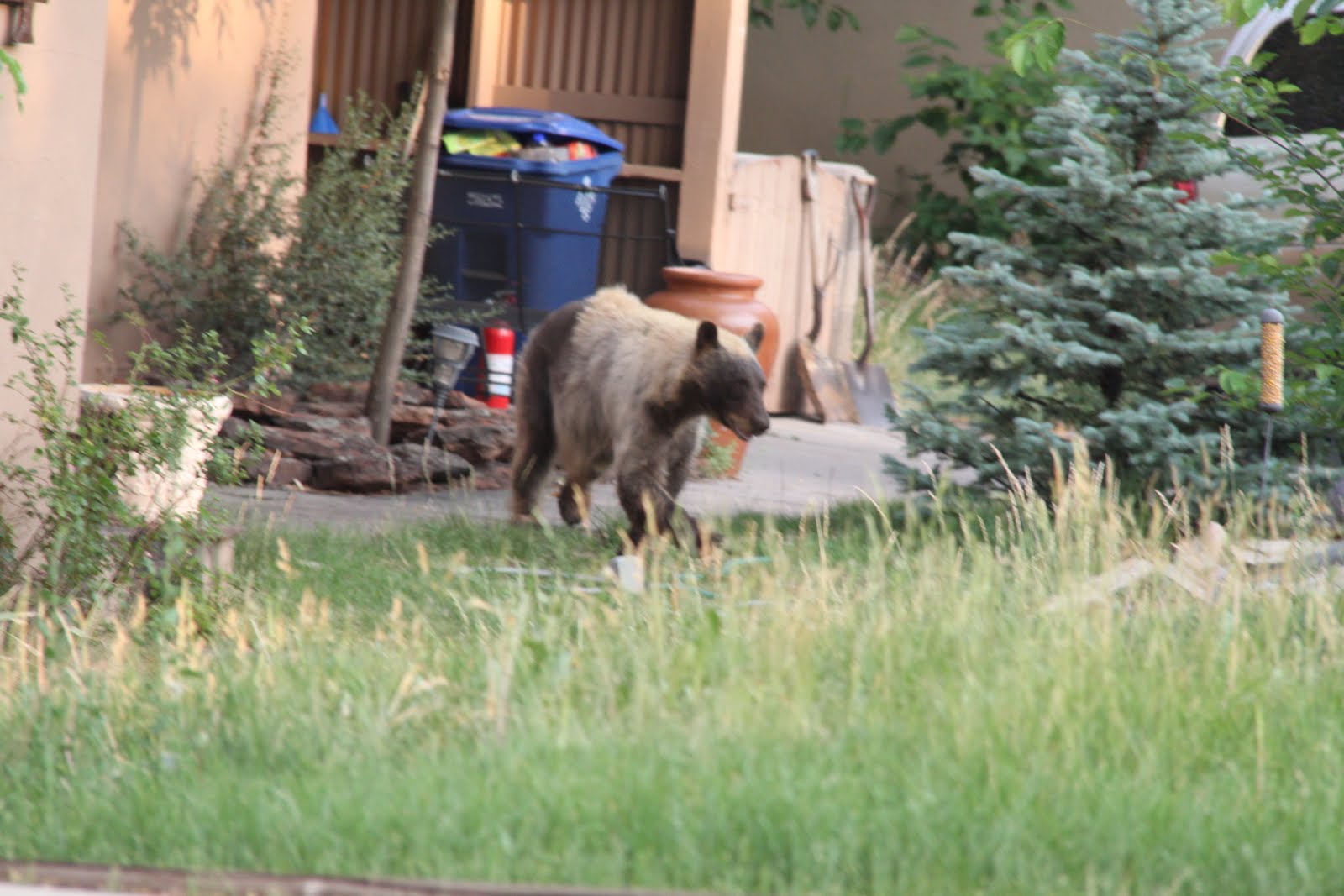 | |
| Now, about dinner.... |
 |
| Cuddles up close. Don't worry for my sanity; that's ~300 mm of effective zoom |
 |
| Some stuff still burning up there. Park the mountain bike for now |
Subscribe to:
Posts (Atom)